
Major amendments to Transfer Pricing Legislation - Applicable for 2025 reporting
At the end of 2025, amendments to the Law “On Taxes and Fees” (section 15.2) significantly changed the transfer pricing landscape in Latvia. The objective of these amendments is, as of 1 January 2026, to modernize the transfer pricing compliance and audit process by reducing the administrative burden on taxpayers and increasing the efficiency of the State Revenue Service (SRS) (increasing taxpayer risks).
The Key Element of the Reform – the Controlled Transactions Report (CTR).
The most significant innovation is the CTR – a standardized and structured summary of controlled transactions, focusing on the most material elements. It constitutes a concise and standardized compilation of data, including information on the type of transaction, its direction, value, counterparty, the transfer pricing method applied, comparable data and the results obtained. The Report will have to be submitted via the SRS Electronic Declaration System (EDS) already for the 2025 financial year, within 12 months after the end of the financial year. The CTR will serve as a supplement to the customary transfer pricing documentation, enabling the SRS to carry out more targeted and automated risk analysis and to identify potential tax risks more efficiently prior to the initiation of audit or control measures.
The new CTR can be compared to a book abstract: instead of the SRS having to read the entire ‘book’ (previously the Master File and Local File) for each taxpayer in order to assess whether transfer prices are appropriate, the SRS will now receive a standardized summary of the key elements, requesting the ‘full book’ only where potential issues or risks are identified.
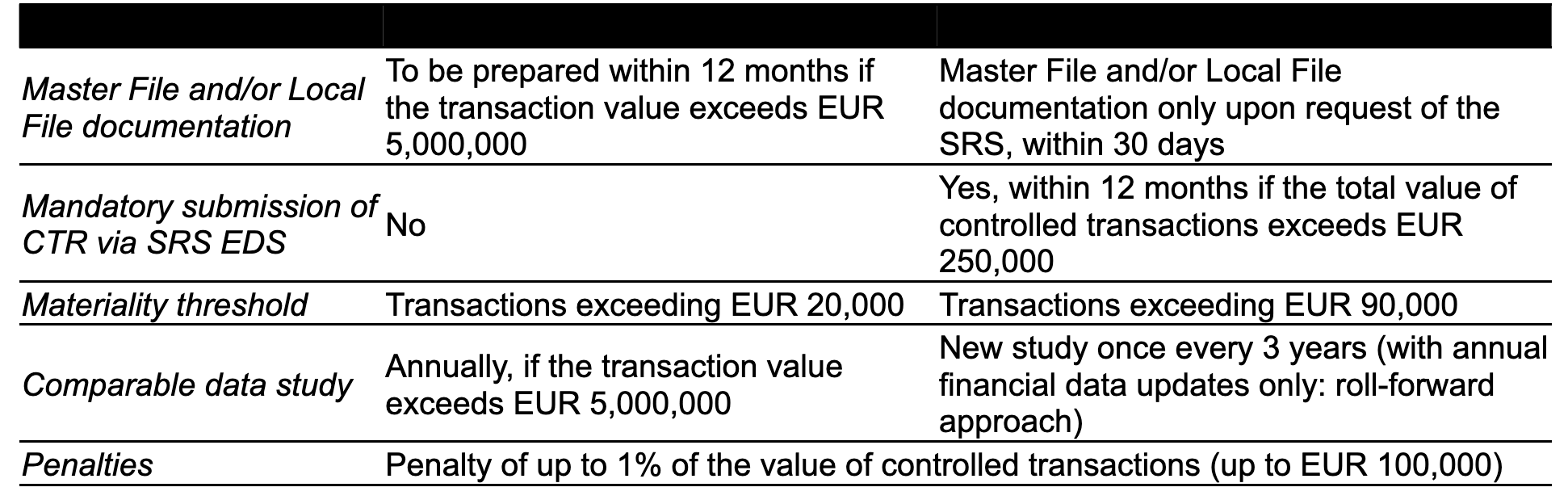
Below is an overview of the requirements applicable to reporting periods up to and from the 2025 reporting years.
Practical Considerations
a) Errors in the application of transfer prices in related-party transactions will be presented to the State Revenue Service (SRS) in a structured manner. Set out below are the most common transfer pricing errors that will form part of the CTR analysis and should be considered during the financial year to mitigate transfer pricing risks in a timely manner, while adjustments to the data are still possible:
- Identical transactions are carried out both with group companies and third-party customers, but prices differ in favor of group companies (resulting in reduced profitability of the local entity);
- The company’s results fall outside the interquartile range, or the stated range is excessively wide (requiring detailed analytical justification);
- External comparables are used in methods based on gross profit indicators (court practice has established that net profit indicators must be used in such cases);
- An atypical method applied to commonly occurring transactions (e.g. the cost-plus method applied to intercompany loan transactions);
- An atypical profit indicator applied to a common type of transaction (e.g. intellectual property transactions analyzed using the cost-plus method);
- Low profitability combined with a significant volume of intra-group transactions (indicating potential profit shifting);
- Rounded amounts in service transactions (indicating a lack of evidence and uncertainty as to the benefits received);
- A markup exceeding 5% applied to low value-adding services received (above the recommended level);
- Significant year-on-year fluctuations in CTR results (indicating atypical transactions, reorganizations, or transfers of assets);
- Atypically high profitability (which may indicate incorrect profit allocation, where the local entity could potentially have been even more profitable), etc.
b) The SRS will accumulate a database of Latvian companies’ transaction data. The introduction of the CTR will allow the SRS to build a database of comparable company data that will not be publicly available but will be used by the SRS in its analytical work and audits. Similar to how employee remuneration levels are currently analyzed against average remuneration in the relevant industry.
c) It is time to act for companies whose transaction volumes with related parties fall within the range of EUR 250,000 to EUR 5 million. Although the previously applicable framework already required companies with such parameters to prepare transfer pricing documentation, this obligation was often ignored, as submission was not mandatory. From the 2025 financial year, the scope of companies required to provide information to the SRS will expand significantly. Even though the transaction volumes may be smaller, reporting will be required from each company, and errors in related-party transactions may prove costly. Moreover, the SRS will have the ability to retrospectively review such incorrectly reported transactions - disclosed via the CTR - and to analyze the transactions of these companies also for 2024 and earlier periods.
Accordingly, a strong emphasis on the accuracy of transfer pricing will lie specifically in the preparation and submission of CTR. Companies are therefore encouraged to consider the preparation of the first-year CTR (for the year 2025 reporting) and to act in a timely manner - prior to the submission of the 2025 annual financial statements. If necessary, companies can still amend the 2025 annual financial statements and/or corporate income tax return without late-payment penalties by making the relevant transfer pricing adjustments.
Contact us to find out if and how our expert knowledge can support and create added value for your business operations!
Related content